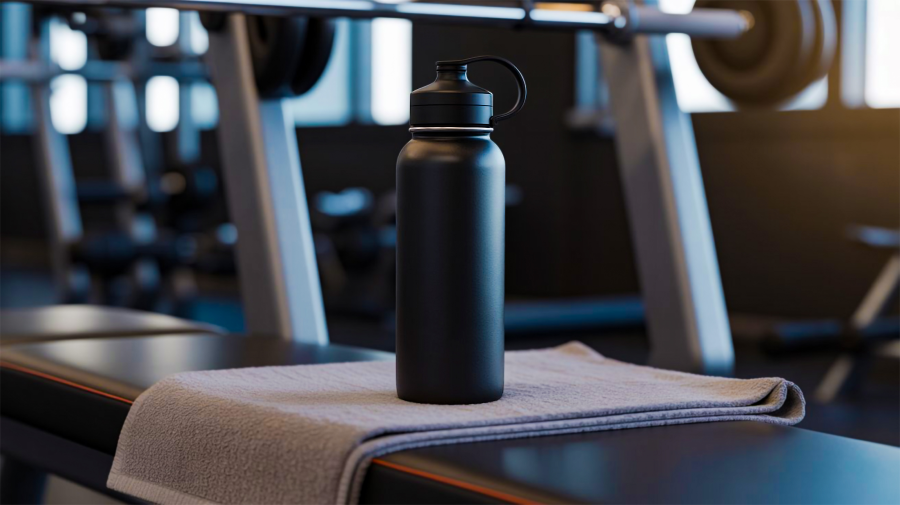
Persistent odor, altered taste and internal stains are common complaints from people who use reusable bottles and squeeze bottles. To the consumer, it looks like a hygiene problem. For manufacturers, brands and quality teams, it is a product problem: it generates complaints, exchanges, reputation damage and lost repurchase.
In most cases, the source of these complaints is biofilm, a microbial structure that forms on the inner surface of bottles and resists ordinary cleaning. In this article, you will learn the main causes of biofilm, why it is hard to remove and which design, material and additive strategies help reduce the problem at its source.
In this guide, you will learn what antimicrobial finishes are, which materials can incorporate the technology, which technical criteria should guide the decision, and how the construction value chain can turn this topic into a competitive advantage.
What biofilm is and why it concerns those who manufacture bottles
Biofilm is a community of microorganisms that attaches to a surface and wraps itself in a protective matrix that the microorganisms produce themselves. This matrix works as a barrier, which makes bacteria more resistant to mechanical cleaning and to many sanitizing agents.
How biofilm forms inside the bottle
The process begins when microorganisms present in the water, in the user’s mouth or in the environment adhere to the inner surface. With moisture and organic residues available, they multiply, form the protective matrix and come to occupy ever larger areas. To understand the basis of this phenomenon, see the content on industrial microbiological control.
The impact on the brand and on operations
Bottles with odor or altered taste lead to returns, negative reviews and customer service costs. In household goods lines, where repurchase depends on the user experience, recurring contamination directly affects the perceived quality of the product.
Main causes of biofilm in bottles
Biofilm rarely has a single cause. In general, it results from the combination of use, product design and material characteristics.
Constant moisture and organic residues
Drinks with sugar, milk, proteins, juices and sports drinks leave residues that feed microorganisms. When the bottle stays closed and damp, the environment becomes favorable for multiplication.
Product geometry and hard-to-reach areas
Narrow necks, threads, straws, spouts and seals create regions that the brush and the water flow do not reach efficiently. These are precisely the points where biofilm formation concentrates and that take the longest for the user to notice.
Surface roughness and micro-scratches
Surfaces with micro-scratches, common after repeated use and washing, offer more anchoring points for microorganisms. The more irregular the surface, the easier the adhesion.
Silicone and elastomer components
Silicone lids, sealing rings and spouts retain moisture and residues easily. Often, the odor consumers complain about originates in these components.
Inadequate or infrequent sanitizing
Washing with water only, incomplete drying and storing the bottle closed while still damp speed up the process. Since part of this routine is beyond the manufacturer’s control, the solution must take real user behavior into account.
How to prevent biofilm: strategies for manufacturers
Reducing biofilm requires a layered approach. No single action solves every scenario, but the combination of design, material and user guidance delivers consistent results.
Product design built for sanitizing
Wider necks, removable parts and smooth inner surfaces make cleaning easier and reduce accumulation points. Considering sanitizing already at the design stage lowers the risk of recurring contamination.
Material selection and surface finish
The choice of polymer and the inner finish influence how easily microorganisms adhere. Materials with a more regular surface that remains stable under repeated use tend to favor cleaning.
Incorporating antimicrobial additives into the polymer
Incorporating antimicrobial technology into the resin creates protection on the product’s own surface, working between one sanitizing and the next. This strategy can also be applied to components such as lids, spouts and seals. How this approach works is explained in the article on antimicrobial additives for plastics, and the broader view on material safety and performance is in the content on technology applied to plastics.
Clear usage and cleaning instructions
Objective instructions on the packaging and in the manual, such as how to disassemble, wash and dry, help the consumer keep the product in good condition and complement the protection built into the material.
How to compare the alternatives before deciding
R&D and procurement teams usually evaluate more than one path. The criteria below help organize the comparison.
- Design review: addresses the causes related to geometry and access, but requires investment in tooling and development time.
- Material or finish change: can reduce microbial adhesion, but does not always solve contamination in sealing components.
- Antimicrobial additive: protects the surface of the material and of the components and is usually integrated into the existing process, but depends on efficacy validation and compatibility with the resin.
- User guidance: low cost and complementary, though dependent on consumer behavior.
In practice, the most robust solutions combine two or more of these fronts.
What to require from an antimicrobial solution for bottles
Proof of efficacy at a recognized laboratory
Request test reports with a methodology suited to the type of polymer and the use of the product. To understand how international validations work, read the article on EPA and FDA certifications for antimicrobials.
Compatibility with the resin and the converting process
The technology must not compromise transparency, color, mechanical strength, odor or processability. Dosage and process adjustment is part of the development described in the content on how the development of technology solutions works.
Safety for use with beverages and food
Because these are products that come into contact with what the consumer ingests, the solution must meet the regulatory requirements applicable to food-contact materials in the target markets.
Durability of protection throughout use
Evaluate whether the protection holds up after repeated washing and prolonged use, which are the real conditions of a reusable product.
Frequently asked questions
Does an antimicrobial additive eliminate the need to wash the bottle?
No. The technology reduces microbial colonization on the surface, but regular sanitizing remains necessary.
Does the protection also apply to lids and seals?
It can, as long as the technology is incorporated into those components and validated for the specific material, such as silicone or other elastomers.
Can it be applied to a product that is already on the market?
Yes, generally by revising the formulation in a new version or batch of the product, with validation tests before the transition.
Next steps
Understanding the causes of biofilm is the first step to addressing it at the source. If your company manufactures bottles, insulated tumblers, squeeze bottles or plastic components for household goods, a technical conversation with the R&D team helps identify the best combination of design, material and additives for your case.