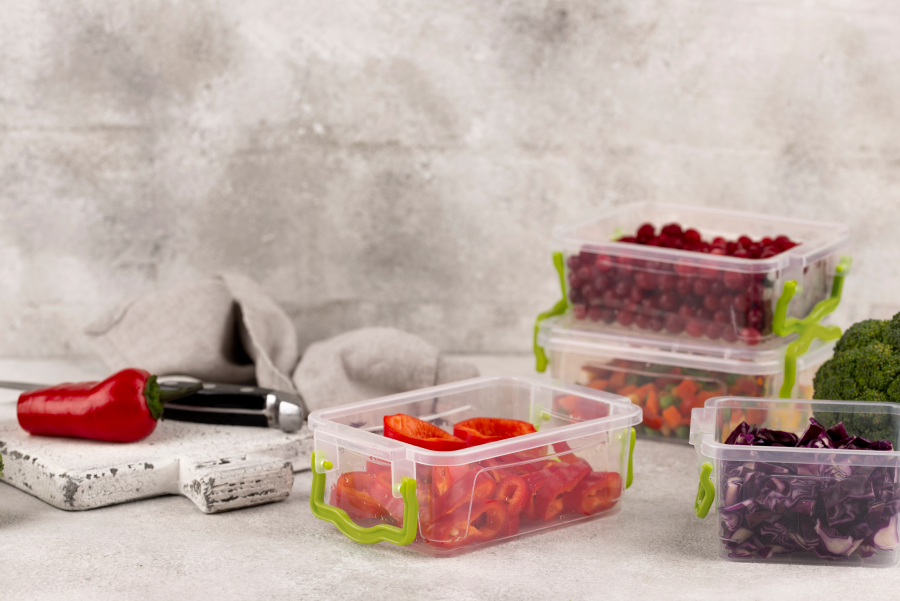
Bottles, squeeze bottles, containers, lunch boxes, cups, cutting boards and organizers have something in common: they stay damp, come into contact with organic residues and are used repeatedly. It is in this context that biofilm forms and starts to generate odor, stains and consumer complaints.
For those who manufacture or sell these products, beyond understanding why biofilm appears, what matters is how to prevent its formation at the origin of the product. This article shows how antimicrobial technology incorporated into the polymer supports product hygiene, how to implement it and how to prove performance.
Where biofilm forms beyond bottles
Any damp plastic surface with residues and difficult access can serve as a base for biofilm.
- Bottles and squeeze bottles: spouts, threads, straws and sealing rings.
- Containers and lunch boxes: lids, inner corners and silicone seals.
- Cutting boards and kitchen utensils: scratches and crevices on the surface.
- Organizers and bathroom and laundry products: areas with constant humidity.
In all these cases, traditional cleaning removes part of the problem, but does not prevent recolonization right after use. The origin of the phenomenon and its impacts on operations were detailed in the content on industrial microbiological control.
How antimicrobial technology works in plastic
Protection built into the resin
The technology is added to the polymer during processing, through masterbatch or compound, and becomes part of the product’s own structure. This way, the protection acts on the surface throughout use, without depending on a later application step. The fundamentals of this approach are explained in the article on antimicrobial additives for plastics.
What the technology does and does not do
It reduces the growth of microorganisms on the material’s surface, which helps limit the formation of biofilm and associated odors. It does not replace sanitizing, does not make the product sterile and does not remove the need for use and cleaning instructions. Communicating this limit clearly protects the brand and strengthens the credibility of the claim.
How to prevent biofilm formation: a three-layer strategy
Layer 1: product design
Smooth inner surfaces, wider necks, removable parts and fewer crevices make cleaning easier and reduce accumulation points.
Layer 2: material and additives
The choice of resin and the incorporation of antimicrobial technology protect the surface of the product body and of critical components, such as lids, spouts and seals.
Layer 3: usage guidance
Clear instructions on disassembly, washing and drying complement the material’s protection and help the consumer keep the product in good condition.
The best solutions combine all three layers. The additive has the advantage of acting precisely in the intervals between cleanings, which is when biofilm begins to form.
How to incorporate the technology into production
Compatibility with the resin and the process
The technology must be compatible with the polymer used and with the process, whether injection, blow molding or extrusion. The goal is to maintain transparency, color, mechanical strength and processability. The technical details of this type of development appear in the content on technology applied to plastics.
Typical implementation steps
- Diagnosis: understand the product, resin, process and complaint to be solved.
- Technology and dosage selection: define the most suitable additive.
- Proof of concept: produce samples and evaluate efficacy and final properties.
- Validation: run tests at a recognized laboratory.
- Industrial pilot: validate consistency at scale.
- Launch: communicate the benefit backed by test reports.
This flow follows the logic described in the article on how the development of technology solutions works.
How to prove performance
Antimicrobial efficacy tests
Proof must be made with standardized methods, applied to the final material, with a report from a recognized laboratory. For plastics, antibacterial activity tests on surfaces are common and, when relevant, so are fungal resistance tests.
Durability after use and washing
Since these are reusable products, it is worth evaluating whether the protection holds up after repeated washing and prolonged use. This data is decisive to support the claim throughout the product’s life.
Regulatory validation
For products in contact with food and beverages, the solution must meet the requirements applicable in the destination markets. To understand how this type of validation works, read the article on EPA and FDA certifications for antimicrobials.
How to communicate the benefit responsibly
Good commercial communication says what the technology does, based on data, and avoids absolute promises. Clear claims, linked to the tests carried out, reduce regulatory risk and increase the trust of distributors and retailers. This care is consistent with what we discuss about sustainability and responsible messaging in industry.
Frequently asked questions
Does the antimicrobial additive change the color or transparency of the product?
It depends on the technology, the dosage and the resin. For this reason, a proof of concept with your material is essential before deciding.
Does the protection also apply to lids and seals?
It can, as long as the technology is incorporated into those components and validated for the specific material.
Can it be applied to a product that is already on the market?
Yes, generally by revising the formulation in a new version, with validation tests before the transition.
Does the technology eliminate the need to clean the product?
No. It complements sanitizing, which remains necessary.