The bench result shows that the technology works in the material. The pilot batch shows that it works in the material, in the machine and at the pace of your factory. Between the two stages lie variables that the laboratory reproduces only in part, such as shear, residence time, cooling and changes of raw material batch. A well-designed pilot reduces the risk of costly adjustments during scale-up and gives the team a data set for the investment decision.
In this article, you will see how to structure the pilot batch of an antimicrobial technology in polymers: objectives, process parameters, sampling, tests and acceptance criteria. To understand the full path from research to production, also read from research to market: how the development of technology solutions works.
What the pilot batch answers
The pilot brings together, in an intermediate-volume production, the questions that the bench leaves open:
- Is the technology distributed homogeneously in the product? Dispersion on the line may differ from what is obtained in the laboratory.
- Does the process tolerate the incorporation? Temperature, pressure and residence time must remain within the material’s window.
- Do the product properties hold? Color, transparency, mechanical strength, sealing and finish are part of the evaluation.
- Does the antimicrobial performance repeat across samples and shifts? Consistency matters as much as the average value.
- Do the costs add up? Dosage, yield and any process adjustment feed the calculation of the final product.
From bench to scale: three steps
- Bench test: defines the technology, the dosage range and the initial performance on test specimens.
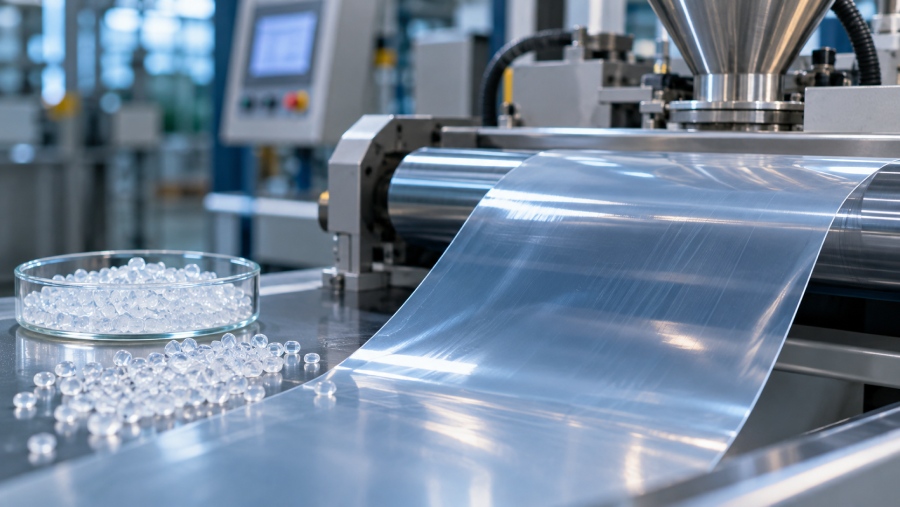
- Pilot batch: reproduces the real process (extrusion, injection, blow molding or thermoforming) at reduced volume, with planned sampling.
- Scale production: runs the validated process, with a quality control plan defined from the pilot data.
Each step uses the learnings from the previous one. A pilot that starts from a bench with a test report and a defined dosage moves forward with fewer iterations.

How to plan the pilot
1. Define the objectives and acceptance criteria before starting the machine
The criteria are the document that turns the pilot into a decision. Examples of items to record:
- Minimum required antimicrobial performance, with the standard and the reference microorganism (for example, ISO 22196 for plastic surfaces).
- Acceptable variation between samples of the same batch and between batches.
- Limits for color, gloss, transparency and mechanical properties relative to the reference material.
- Approved process window (temperatures, speed, cycle time).
- Regulatory requirements of the destination market, such as those for food contact, when applicable.
2. Choose the incorporation route
In polymers, masterbatch usually facilitates dosing and dispersion on the line.
3. Document the process parameters
Record temperature by zone, screw speed, residence time, pressure, line speed and cooling conditions. These data allow the result to be repeated at scale and any deviation to be investigated.
4. Plan the sampling
Take samples at the start, middle and end of the run, and across more than one shift when possible. Distributed sampling shows process stability and reduces the risk of deciding based on a single favorable point.
5. Include a reference material
Produce, under the same conditions, samples without the technology. The direct comparison isolates the effect of the incorporation on performance and on product properties.
Pilot tests
- Antimicrobial efficacy: standardized method in an accredited laboratory, applied to the pilot samples. The guide on antimicrobial efficacy tests and applicable standards details the options by material type.
- Physical and mechanical properties: tensile, impact, stiffness, sealing and other tests that the application requires.
- Visual properties: color, gloss and transparency, measured with instruments and compared to the reference.
- Dispersion: visual or instrumental analysis that confirms homogeneous distribution.
- Aging and use: washing, abrasion, exposure to heat or UV, according to the product’s use environment, to estimate the durability of performance.
- Migration: in food packaging, tests according to the regulation of the market.
How to read the results
Compare each result with the criteria defined in the planning. Three scenarios help organize the decision:
- Criteria met: the pilot approves the process and the dosage, and the team moves on to the scale control plan.
- Specific adjustment: one parameter fell outside the range (for example, dispersion in one zone of the run). A new short pilot, with the parameter revised, confirms the correction.
- Formulation review: the set of results indicates a change in dosage or incorporation route, and the cycle returns to the bench with the line data as the starting point.
From approval to scale
What is the ideal size of the pilot batch?
The volume depends on the machine and the product. The batch must be large enough to stabilize the process, allow sampling at different moments of the run and supply all planned tests.
Does the pilot need to repeat all bench tests?
The pilot prioritizes the tests linked to the acceptance criteria: antimicrobial efficacy, product properties, dispersion and, when applicable, migration and aging. The others can be repeated according to the project’s needs.
How long does in-line validation take?
The timeline varies with product complexity, line availability and laboratory time for the tests. A schedule aligned before the pilot begins avoids stops between production and analysis.
Who takes part in the pilot?
In general, R&D, Quality and Process Engineering from the industry, with technical support from Nanox in defining dosage, parameters and interpreting the results.
Next steps for your company
The starting point is to gather the bench result, the material data sheet and the description of the line (equipment, temperatures and volume). With these data, the Nanox R&D team and your team define the objectives, initial dosage, sampling and acceptance criteria of the pilot batch.