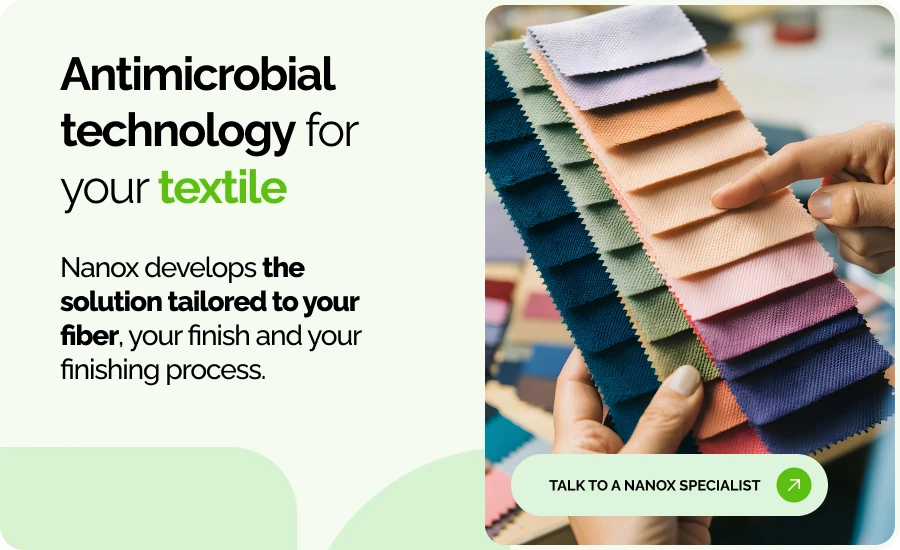
Uniforms, bed linens, towels, rugs, upholstery and sportswear share a challenge: damp, frequently used fabrics offer conditions for bacteria to multiply, which contributes to odors and erodes the perception of cleanliness. Textiles with antimicrobial technology can help maintain the feeling of freshness and simplify everyday care.
In this article, you will learn about the routes for incorporating the technology into a textile, the criteria that R&D and Quality teams should evaluate, and the tests that prove performance.
Bactericidal and bacteriostatic: a useful distinction
The term bactericidal refers to an action that eliminates bacteria, and bacteriostatic to an action that inhibits their multiplication. Technical data sheets and test reports use both expressions, and knowing which one describes the result helps when comparing proposals.
Three routes to bring the technology to the textile
|
Route
|
How it enters
|
Points of attention
|
|
Fiber incorporation
|
In the extrusion of synthetic yarns, such as polyester, polyamide and polypropylene
|
Compatibility with the resin and the spinning process
|
|
Finishing by exhaustion or impregnation (foulard)
|
On the finished fabric, during finishing
|
Fixation to the fabric and wash resistance
|
|
Coating or printing
|
In a layer applied to one side of the fabric
|
Hand feel, drape and uniform coverage
|
Criteria to evaluate performance
Lists of authorized substances are updated periodically. In Brazil, RDC 963/2025, of February 20, 2025, amended RDC 326/2019 and added new substances to the positive list of additives, among them one with use restricted to antimicrobial agent, as reproduced by LegisWeb. In export markets, regulatory requirements follow the same logic of periodic revision. The article on European Union regulations on single-use plastics shows how a European regulatory topic changes the packaging of a product.
- Efficacy against odor-associated bacteria: proven in a recognized laboratory, with a methodology compatible with textiles.
- Resistance to wash cycles: the efficacy test is repeated after home or industrial washes, in a number compatible with the product’s service life.
- Skin contact: the solution must meet the safety requirements of the destination market for products used close to the body.
- Process compatibility: dyeing, printing, hand feel, drape and fabric color are part of the test plan.
- Supplier documentation: test reports, technical data sheets and declarations that support communication to the end customer.
Tests that prove performance
In textiles, laboratories use methods such as ISO 20743, AATCC 100 and ASTM E2149, which measure the reduction of bacteria on the treated sample compared with untreated fabric. Antimicrobial technology in textiles appears in sports uniforms, work uniforms, hospitality linens and rugs.
Frequently asked questions
Does the technology change the hand feel and drape of the fabric?
The effect depends on the route and the formulation. For this reason, the evaluation includes hand feel, drape and color before industrial scale-up.
Does the protection remain after washing?
Durability is measured in tests that repeat the efficacy after wash cycles. The result indicates how many cycles the fabric sustains with the performance defined in the specification.
Does a textile with antimicrobial technology eliminate the need for washing?
Washing remains part of care. The technology acts between one wash and the next and contributes to the freshness of the fabric.
Next steps for your company
The path begins with defining the fiber, the finishing process and the expected service life of the product. With these data, the technical team indicates the most suitable route and the test plan, including evaluation after washing.