
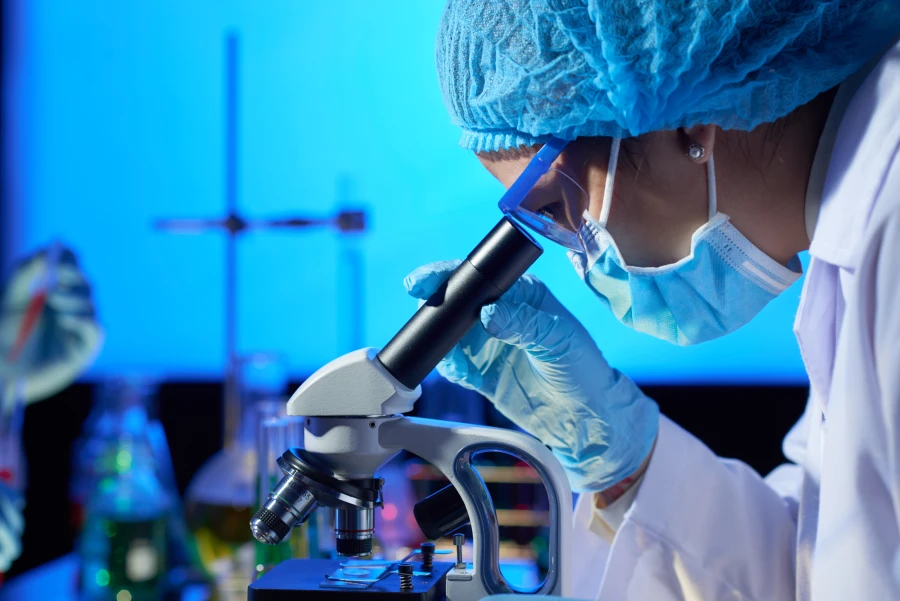
Developing advanced material solutions is a complex process that turns scientific research into real applications for industry. Through stages that include laboratory testing, industrial validation and rigorous certification, technologies such as antimicrobial solutions reach the market supporting safety, durability and efficiency in sectors such as healthcare, packaging, cosmetics and construction.
Advanced material technology is transforming industries with smarter, safer and more efficient materials. But how do these innovations move from the laboratory to the market?
The development of these solutions follows a rigorous process that involves scientific research, laboratory testing, industrial validation and scalability. Innovative companies such as Nanox play an essential role in this process, ensuring that new materials are viable, effective and safe for commercial application.
This article explores the stages of development, the challenges involved and the trends shaping the future of the sector.
What is advanced material development and why does it matter?
This field works with materials at the atomic and molecular scale, creating structures with unique properties. The technology makes it possible to develop lighter, stronger, antimicrobial, easier-to-clean and more sustainable materials, with applications in plastics, textiles, healthcare, cosmetics, electronics and construction.
For a new solution to reach the market, it must go through a complete cycle of research, development and validation. This process confirms that materials meet the performance, safety and regulatory standards required by each sector.
The stages of development
The creation of new solutions goes through several phases, from scientific discovery to large-scale production.
1. Research and innovation: the foundation
Everything begins in the laboratory, where scientists and engineers study how particles can improve the properties of different products.
At this stage, researchers study:
How particles interact with surfaces and substances.
The efficacy of antimicrobial, conductive or resistant particles.
The environmental impact and safety of materials in different applications.
Real example: research on silver ions led to the development of antimicrobial plastics, used today in packaging and hospital equipment.
2. Laboratory testing: validating performance
After the research phase, materials undergo rigorous testing to validate their properties and confirm they perform as expected.
Key tests include:
Antimicrobial efficacy: assessment of the material’s ability to reduce bacteria and fungi.
Resistance and durability: wear and performance tests under different conditions.
Safety and biocompatibility: evaluation of impacts on health and the environment.
The results determine whether the solution is ready to move on to industrial application or requires adjustments.
3. Prototyping and industrial pilot application
After laboratory validation, the technology is applied to prototypes to verify its efficacy under real conditions. This may include tests on production lines, packaging, surfaces and medical devices.
At this stage, companies evaluate:
How the material performs in real-use environments.
Whether the technology maintains its properties at industrial scale.
The economic feasibility of large-scale production.
Success case: the adoption of antimicrobial particles in textiles led to the development of safer, more durable sportswear and hospital garments.
4. Regulation and certification: supporting safety
Before reaching the market, every innovation must comply with global regulations that confirm it is safe for use.
Main certifications involved:
Anvisa, FDA and European Union standards, depending on the sector.
Antimicrobial safety certifications for hospital and food products.
Sustainability and environmental impact assessments.
This process is essential for the technology to gain market acceptance and be applied to products safely and legally.
5. Industrial scale-up and commercialization
After all testing and certification, the technology is ready for large-scale production and commercial application.
At this stage, the main challenges are:
Reducing production costs while maintaining efficiency.
Adapting the technology to the specific demands of each sector.
Integrating the innovation into companies’ production chains.
Practical example: packaging companies already use this technology to extend product shelf life, reducing waste and adding value for the market.
The challenges of development
Turning scientific innovation into market-ready solutions requires overcoming several challenges:
Research and development costs, which can be significant.
Validation time, which depends on rigorous testing and regulatory approval.
Scalability, to make the technology economically viable in large-volume production.
Specific regulations, which vary according to the sector and the material’s application.
Nanox is at the forefront of this process, accelerating the development and implementation of safe and effective solutions for different markets.
The future: trends and innovations
As the technology advances, new trends emerge:
Easy-care plastics and textiles, reducing the need for maintenance.
Cosmetics with particle-based technology, offering improved absorption and efficacy.
Smart packaging, which indicates the condition of food.
High-performance antimicrobial surfaces for hospitals and public transportation.
At Nanox, we continue at the frontier of innovation, developing technologies that transform materials and add value to the market.
Conclusion: from science to market
Advanced material technology is already transforming industries today. From initial research to commercialization, development involves a rigorous process of validation, safety and scalability.
Companies that adopt this innovation gain a competitive edge, offering smarter, more sustainable and more efficient products.